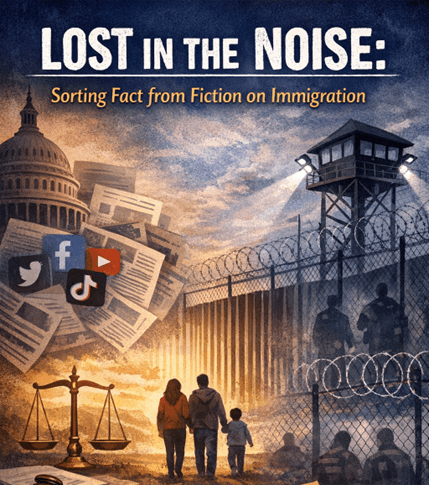
In this moment of tailored algorithms and selectively delivered information, it can be difficult to know what to think, especially when you and your neighbor may be receiving completely different information based on preferences, engagement incentives, and attempts to capture your attention that you didn’t choose and probably don’t fully understand (I know I don’t). On top of all that is the uncomfortable reality that almost everything right now is complex.
When my ethics students ask me questions about current events and what we should do, the thing I find myself saying most often is: “It’s complicated.” That response is particularly apt in this moment, when we live in different information bubbles and try to navigate conflicting narratives. Are civil liberties eroding before our eyes? Or is what we’re seeing a necessary correction in the name of security and law enforcement? Is enforcing immigration policy with ICE enforcement, detention, and deportation of over 675,000 people (according to a January Press Release) necessary?[1] Or are our neighbors, children, parents, friends, and employers living through a campaign of cruelty?
This issue is indeed complicated. But we can’t stop the conversation at the point where we recognize this complexity, because doing so often leaves thoughtful, well-intentioned people feeling paralyzed: I don’t know enough. What if I get it wrong? What if I only have part of the story? These doubts can trap us in non-action. All too often, the people most willing to speak with certainty on complex issues are either deeply motivated and narrowly focused or simply overconfident in their own views. In the face of conflicting and complex information, it becomes all too easy to dismiss anything that doesn’t fit our narrative of the current situation. How often have even the best of us, in terms of “doing our own research,” drilled in on a piece of information that felt “suspicious” (i.e., doesn’t fit cleanly with what we think) but not done the same for information that already “fits.” Let’s face it, it’s hard right now to separate misinformation from good information, let alone hold seemingly contradictory pieces of the puzzle together to understand polarizing issues like immigration.
This paralysis, and the tendency to tune out credible information that challenges what we think we know, is made worse by misinformation and obfuscation repeated over and over until they become the prevailing narrative. In my work, I encounter many misunderstandings about immigrants and the immigration system. These misunderstandings cause genuine confusion and lead to untrue beliefs among people who actually share similar values of freedom, fairness, and family, and who would be willing to take a stand if they felt those values were being threatened.
There are three particularly damaging misunderstandings that have plagued the conversation around immigration and how people who are immigrants are living in the United States. These misunderstandings destabilize us and make it difficult to see the threat to our shared values and democracy amid the noise rushing around us.
These misunderstandings are not merely errors. They keep us frozen and unable to see when our values are at stake.
Many people are surprised to learn that for many immigrants who don’t have status, there was never a “right way” to immigrate. A large portion of people living in the United States did not come through a formal, permanent immigration process, and couldn’t have done so even if they had the time, resources, and knowledge to navigate the U.S. Immigration system from their home countries. The U.S. immigration system is incredibly complex and constantly changing.[2] There are strict quotas, limited pathways, and narrow eligibility criteria. Immigration categories are also divided by skill level, with more opportunities allocated to higher-skilled individuals from certain countries.
For low-income immigrants from places like Mexico, especially those without formal education, there are extremely limited legal pathways to migrate permanently. Work-based immigration in sectors like agriculture is short-term, expensive, and highly restrictive.[3] Many people who come to the U.S. without authorization are fleeing severe conditions and may meet the criteria for asylum status. Asylum seekers (people with a genuine case for asylum who are already in the United States) face a difficult battle proving their case, as the requirements and burden of proof are extremely high. The number of refugees (people who meet the definition for asylum and are applying from outside the country) and the countries from which the United States accepts them is determined in a presidential decree each fiscal year. In a 2025 executive order, President Trump suspended the U.S. Refugee Admissions Program (USRAP) with limited exceptions, resulting in the lowest number of refugees admitted, including during the pandemic.[4]
Many of the programs that have allowed people to immigrate in the past have changed or not been renewed. For example, many people from Mexico living in Arizona originally came to the United States through the “Bracero Program,” a guest-worker program that operated from 1942 to 1964. When the program ended, legal pathways for low-wage Mexican laborers largely disappeared, even as demand for their labor remained.[5] This created strong labor demand with no legal path for people, resulting in a huge demand for undocumented agricultural labor.
Additionally, there is very little space for people who came here without documentation (not through a formal immigration process) to “regularize” their status after the fact. Some options have existed for people who have overstayed a visa for example, but if you didn’t come here with a travel or work visa (how many people who are undocumented from Mexico have come to the country, including children brought over by their parents) there is generally no viable path to gain status after they are in the country. There are some exceptions here for special visas with strict eligibility requirements, such as the Violence Against Women Act (VAWA).[6]
Many people are surprised to learn that most immigrants living in the United States have no criminal history outside of the offense of improper entry.[7] As of data current to January 25th, 2026, 52,504 out of 70,766, or 74.2% held in ICE detention have no criminal conviction.[8] Many of those with convictions had only minor offenses, including traffic violations. Most undocumented immigrants are mothers, fathers, sisters, and brothers who are doing the best they can for their families in a system where they are vulnerable to exploitation and abuse.
People who are here without formal status are extremely vulnerable and have to contend with exploitation, lack of protection both in labor and legally, and a constant fear of deportation. This was before the current administration. Many undocumented immigrants are victims of many different crimes, sexual abuse, labor exploitation, but don’t appeal to police for protection because of fear of retaliation and deportation. Because of this vulnerability, most undocumented immigrants work hard to avoid police contact and are often deeply afraid of law enforcement.
Many people are surprised to learn that conditions in immigration detention facilities are not consistently monitored and that there are growing reports of serious human rights violations, including allegations that meet international standards for torture.
Many people do not realize that immigration is not part of the criminal legal system. This means that protections people assume apply when someone is arrested, such as a guaranteed trial, do not apply in immigration proceedings. There is no right to a government-appointed attorney, meaning that if you want an attorney, you must pay for one yourself or find a legal aid non-profit to take your case. Also, immigration courts are part of the Department of Justice, under the executive branch, and do not operate with the same structural independence as Article III criminal courts.
This is compounded by recent policy changes that have sharply restricted bond eligibility for many cases.[9] As a result, once someone is taken into custody by ICE or CBP, they may be held without bond until their case is heard by an immigration judge. Most people are forced to face a complex, overburdened legal system in a language they might not understand, but certainly a vocabulary that most native English speakers would struggle to navigate without existing legal expertise, and which is hostile to their claims. For low-income individuals already at a disadvantage, detention can make it nearly impossible to gather evidence, secure legal help, or meaningfully prepare a defense.
ICE uses a mix of private, government-run, and partner facilities, and the number of detention sites has increased significantly in the past year.[10] Multiple investigations have documented abuses in detention centers, including a recent report from Jon Ossoff’s office documenting over 1,000 credible allegations that, according to advocates and investigators, meet international standards for cruel or degrading treatment, including medical neglect, denial of food and water, mistreatment of pregnant women and children, physical and sexual abuse, and multiple deaths in custody. [11] Independent reporting by the ACLU at facilities such as Fort Bliss further documents accounts of physical assaults, sexual abuse, medical harm, and intimidation tactics used to pressure people into agreeing to deportation.[12]
So far in 2026 at least six people have died in immigration detention. At the same time, serious concerns about access to health care and health conditions inside detention centers continue to be raised, including ambiguity and issues in finding people who are hospitalized while in ICE custody.
Oversight and access raise additional concerns about the rapidly expanding detention network. Members of Congress have publicly reported being denied or delayed entry when attempting to inspect detention facilities, and courts have intervened in disputes over advance notice requirements for oversight visits. Attorneys have similarly described difficulty accessing clients in immigration custody. These disputes do not prove abuse in every case. But when detention expands, oversight becomes harder, and access to lawyers becomes uncertain, increasing the risk to transparency and due process.
In this moment, it can be hard to know what and who to believe, especially when misinformation is repeated until it begins to feel like the truth. The speed of information, the intensity of competing narratives, and the complexity of the law make it easy to disengage or retreat into certainty. But now, maybe more than ever, it is crucial to be both careful and brave with our opinions and our information. Careful enough to verify what we repeat. Brave enough to examine whether the stories we are telling align with our deepest values.
People are suffering in very real ways, in detention centers, in courtrooms, in workplaces, and in their own homes, in our communities. And too often our public conversations orbit around abstractions, slogans, or partisan talking points rather than the lived realities of people. If we are going to disagree, and we will, let it at least be over facts honestly examined and values honestly stated. Anything less leaves us arguing in circles while harm continues in the background.
[1] Homeland Security. (2026, January 20). DHS sets the stage for another historic, record-breaking year under President Trump. Press Releases. https://www.dhs.gov/news/2026/01/20/dhs-sets-stage-another-historic-record-breaking-year-under-president-trump
[2] How the United States Immigration System Works. American Immigration Council. (2025a, November 12). https://www.americanimmigrationcouncil.org/fact-sheet/how-united-states-immigration-system-works-fact-sheet/
[3] ‘USCIS. “Cap Count for H-2B Nonimmigrants,” March 26, 2025. https://www.uscis.gov/working-in-the-united-states/temporary-workers/h-2b-non-agricultural-workers/cap-count-for-h-2b-nonimmigrants.
[4] The United States Government. (2025, January 21). Realigning the United States Refugee Admissions Program. The White House. https://www.whitehouse.gov/presidential-actions/2025/01/realigning-the-united-states-refugee-admissions-program
[5] Library of Congress, “1942: Bracero Program,” A Latinx Resource Guide: Civil Rights Cases and Events in the United States – Research Guides at Library of Congress. (n.d.). https://guides.loc.gov/latinx-civil-rights/bracero-program
[6] USCIS. “Green Card for VAWA Self-Petitioner,” April 8, 2025. https://www.uscis.gov/green-card/green-card-eligibility/green-card-for-vawa-self-petitioner.
[7][7]This is a sticky point that needs elucidation carefully. In 1965, with the passage of the “Immigration and Nationality Act of 1952,” entering without inspection (not coming through a port of entry or being inspected by an immigration officer was codified as a misdemeanor for a first offense, and a felony on the second. Being present in the United States without documentation is not and has not been a crime; the offense is entering without inspection (therefore, this does not apply to people who come, for example, on a work visa and overstay). The relevant law was codified as 8 U.S. Code § 1325 – Improper entry by alien in 1986. In 1990 the language was amended to remove the statement that first offense would be treated as a misdemeanor now the law is fuzzy and states “for the first commission of any such offense, be fined under title 18 or imprisoned not more than 6 months, or both, and, for a subsequent commission of any such offense, be fined under title 18, or imprisoned not more than 2 years, or both” (1). For a detailed brief of the law and the slippery way that criminal is used, please see the ACLU’s brief “” (2).
- Cornell Law School. (n.d.). 8 U.S. Code § 1325 – improper entry by alien. Legal Information Institute. https://www.law.cornell.edu/uscode/text/8/1325#a
- ACLU. (2010, February). Criminalizing undocumented immigrants. IRP issue brief. https://www.aclu.org/sites/default/files/field_document/FINAL_criminalizing_undocumented_immigrants_issue_brief_PUBLIC_VERSION.pdf
[8] Immigration Quick Facts. Tracreports.org. (n.d.). https://tracreports.org/immigration/quickfacts/
[9] American Civil Liberties Union. (2025, December 1). Federal Court affirms nationwide class has right to bond hearings . Press Releases. https://www.aclu.org/press-releases/federal-court-affirms-nationwide-class-has-right-to-bond-hearings
[10] Ice detention trends. Vera Institute of Justice. (n.d.). https://www.vera.org/ice-detention-trends
[11] Office of Senator Jon Ossoff. “U.S. Immigration Detention Oversight.” https://www.ossoff.senate.gov/wp-content/uploads/2026/01/260114_Report_Patterns_v5.pdf
[12] Gassama, H. (2026, January 26). Immigrants detained at Fort Bliss in Texas report abuse and inhumane conditions. American Civil Liberties Union. https://www.aclu.org/news/immigrants-rights/detained-immigrants-detail-physical-abuse-and-inhumane-conditions-at-largest-immigration-detention-center-in-the-u-s
 Aubrial Harrington
Leave a comment